
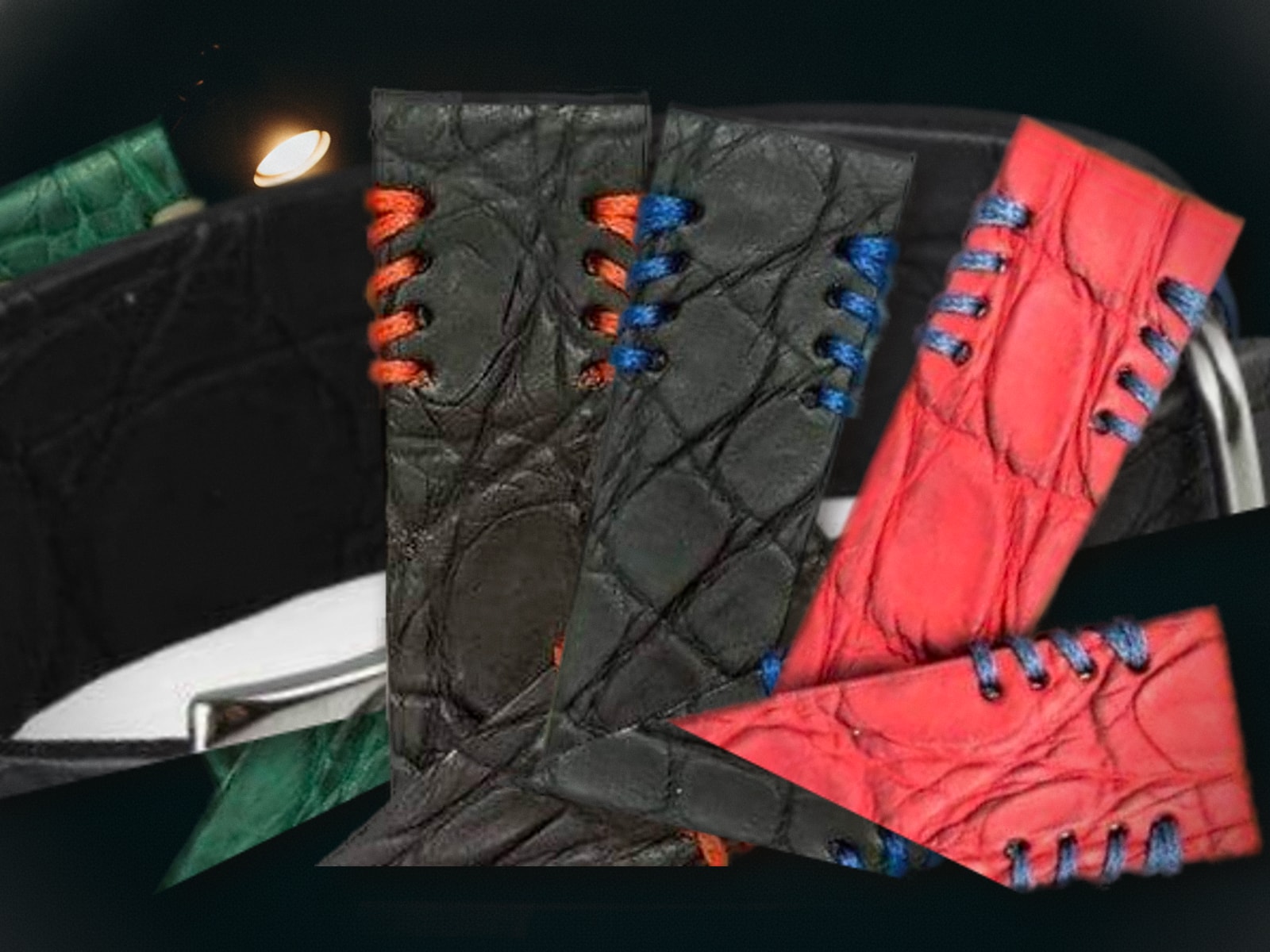
MILANO STRAPS · NILE CROCODILE
Nile Crocodile — the oldest leather in high watchmaking


Frequently asked questions
How do you distinguish Nile crocodile from alligator?
The main difference is in the central pit on each belly scale: in niloticus there's a small dot marking the hair follicle, in alligator there isn't. Niloticus scales are also more irregular and asymmetrical. To the naked eye, someone who knows materials sees it immediately. For those unfamiliar with them, it's a good opportunity to learn.
Is Nile crocodile legal and certified?
Yes — I work exclusively with CITES-certified leather from controlled farms in Africa. Each niloticus strap comes with traceability documentation. It's a purchase you can make with peace of mind, knowing the supply chain is verifiable from farm to European tannery to atelier.
Which watches do you pair with Nile crocodile?
I pair it with haute horlogerie watches that can carry the presence of the leather: Vacheron Constantin Patrimony, A. Lange & Söhne Lange 1, Jaeger-LeCoultre Master Ultra Thin. On these, niloticus makes sense. For a daily Rolex I prefer alligator — more discreet, more practical. Niloticus is a conscious choice, not an automatic one.
What makes Crocodylus niloticus different from other exotic leathers?
Crocodylus niloticus has irregular scales with asymmetrical pattern and a central pit on each scale. It's the exotic leather with the longest history in haute horlogerie. Available in 18, 20 and 22mm. Patina stratifies color over time, giving depth to the scales that other leathers don't reach.
How do you clean and care for a Nile crocodile strap?
Every pit on the belly of niloticus collects dust and sebum. Clean with a slightly damp microfiber cloth every 2-3 months. No harsh products: the irregular scales absorb more than alligator. A light neutral conditioner, applied sparingly, keeps the scales compact without letting them open.
What distinguishes niloticus scale from alligator scale?
Alligator has symmetrical, almost geometric scales. Niloticus is more alive: asymmetrical pattern, central pit on each scale, stronger presence. Less regular — more character. Available from 18 to 22mm.
How is a made-to-measure niloticus strap born in the Casati atelier?
At Via XX Settembre 15, Milan, we choose the leather together — niloticus on your watch, lug width measured in the atelier. You don't buy online. You book an appointment, via WhatsApp or directly at the workshop.
How does Nile crocodile leather change over time with use?
Patina stratifies slowly, scale by scale. Color gains depth — it doesn't become uniform, it enriches. On a 20mm strap worn daily, the result after months of use is a surface that looks painted from within.
The next step
The right strap isn’t chosen. It is built, together.
From the atelier appointment to delivery, every step is made for those who know that things done well take time. Rare leathers, one piece at a time, eighteen months of warranty.
Request an appointment →What we offer
- We guide you through every step — with exclusive images directly from our atelier
- Over 50 artisanal steps for each strap — from leather selection to final stitching
- The time it takes to do extraordinary things — four, five weeks. Not a day less.
- An object designed to last a lifetime — cared for by us for eighteen months
- The right leather for your watch — chosen together, in the atelier, only for you
By appointment only · Milan