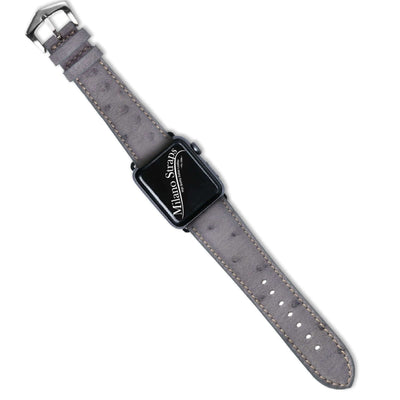
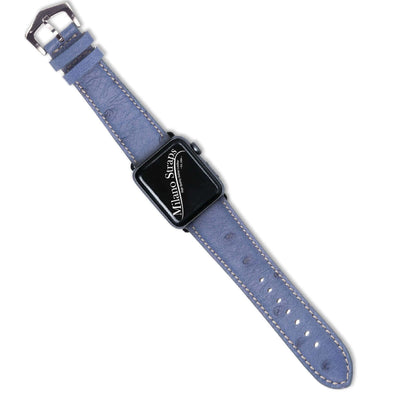
AFRICAN OSTRICH
What is African Ostrich Leather
African ostrich leather — derived from Struthio camelus, bred in the Cape regions, Zimbabwe, and Namibia — is among the most technically complex and immediately recognizable exotic leathers in the entire global leather industry. Its modern commercial history began in the 19th century in the European colonies of South Africa, when Dutch and British settlers realized the commercial value first of the feathers — used in Parisian and London haute couture — and then of the leather itself, which was extraordinarily dense, flexible, and possessed an irreproducible morphological pattern. The South African tanning industry, now concentrated mainly in the Oudtshoorn area of the Western Cape province — which alone produces over 80% of globally traded ostrich leather — has developed over one hundred and fifty years a vertical supply chain of absolute excellence, from controlled breeding to tanning, often vegetable or combined chrome, up to the selection of first-grade leathers intended for luxury leather goods. An adult ostrich, which can reach 150 kg in weight and exceed 250 cm in height, provides generously thick leather, with a dorsal surface — the so-called quill zone — characterized by the unmistakable raised feather follicles, the true anatomical signature of this material.
Characteristics and Properties
What distinguishes African ostrich leather from any other exotic is the very nature of its grain: the feather follicles, arranged in an irregular but harmonious pattern on the animal's dorsal section, create a three-dimensional texture that no artificial process can faithfully replicate. Each skin has a unique distribution of nodules, which is why every ostrich product is, by definition, a singular piece. The internal fibrous structure is particularly intertwined and compact, which gives the leather exceptional tensile strength despite its softness to the touch, comparable — in its well-tanned version — to high-quality lamb nappa. With use and time, the surface develops a natural patina of great character, where the follicles tend to acquire darker shades compared to the surrounding plain, accentuating the relief and three-dimensionality of the grain.
| Property | Assessment |
|---|---|
| Pattern Recognition | Maximum — unique feather follicles for each specimen |
| Softness to the touch | Very high — intertwined fibers and refined tanning |
| Mechanical resistance | Superior to the average of exotics due to fibrous density |
| Patina development | Excellent — chromatic differentiation of follicles/plain over time |
| Available thickness | 1.0–2.0 mm after artisanal trimming for strap loops |
| Compatibility with dyes | Excellent — absorbs flat colors and shades uniformly |
Why it is a Precious Material
In the context of high-end watch leather goods, African ostrich leather occupies a position of absolute privilege for one fundamental reason: it is a material that imitates no other. While many exotic leathers are used for their rarity or aesthetic pattern, ostrich combines both qualities with a tactile rendering that few animal raw materials can match. The artisanal processing of ostrich leather intended for a watch strap requires specific skills: the selection of the dorsal panel — the only area with raised follicles, representing about 40% of the animal's entire surface — is done manually, discarding sections with broken, asymmetrical, or irregularly crusted follicles. Tanning, predominantly vegetable in the best specimens intended for luxury leather goods, is carried out in vats or drums to ensure uniform penetration, followed by hot oiling operations with natural oils that impart its characteristic softness and resilience. Caliper trimming, performed to a constant thickness using an artisanal skiving machine, preserves the relief of the follicles without compromising their three-dimensional structure. The result is a material that ages with dignity, gaining character without degrading.
Use in Watch Straps
In watchmaking, the African ostrich leather strap represents a choice of immediate visual recognition and great material sophistication. The loops are cut prioritizing the central follicular zone, so that the nodules are symmetrically positioned along the longitudinal axis of the strap, creating an orderly visual effect despite the natural irregularity of the pattern. The stitching — usually done by hand with silk thread or waxed nylon in a double saddle stitch — must be calibrated not to deform the surrounding grain, an operation that requires a thin-section needle and a steady hand. The back of the strap is lined with bovine leather or smooth calfskin to ensure comfort on the wrist and dimensional stability of the loop. From the point of view of pairings, ostrich leather naturally lends itself to formal and semi-formal timepieces: yellow or rose gold cases enhance the warm tones of cognac brown or tobacco, while brushed steel finds its ideal counterpart in slate grays or blacks with a cool undertone. Watches with simple dials — from classic dress watches by Swiss manufacturers to elegant chronographs — find in the ostrich strap a variation that adds character without overpowering the timepiece. Also available with a deployant clasp or pin buckle in metal coordinated with the case, the African ostrich strap adapts to standard and custom lengths.
Maintenance and Care
African ostrich leather, while naturally robust, requires a regular maintenance protocol to preserve the vitality of the grain and the brightness of the color over time. The raised follicles are the area most exposed to mechanical wear from rubbing: it is advisable to avoid prolonged contact with abrasive surfaces and to store the strap in a soft case when not worn. For ordinary cleaning, a lightly dampened microfiber cloth is sufficient, passed with gentle circular movements around the follicles; categorically avoid immersion in water or exposure to alcohol-based detergents, which attack the natural oils of the tanning. Periodic nourishment — every three or four months under normal use conditions — with a specific cream for exotic leathers based on lanolin or beeswax maintains the softness of the fibers and slows down the appearance of micro-cracks on the surface between the follicles. Prolonged exposure to direct sunlight can alter the color unevenly, accentuating the contrast between nodules and surface; therefore, store in a cool place away from UV rays. An ostrich strap regularly cared for develops a very personal patina over time, which tells the story of its wearer's use and life.
Frequently Asked Questions about African Ostrich
Authentic ostrich leather features three-dimensional feather follicles — actual hemispherical caps — distributed irregularly but organically on the dorsal area. To the touch, each nodule is perceptible under the fingertip as a soft, discreet protrusion. Imitations in embossed leather reproduce the visual pattern but are flat to the touch, with follicles engraved rather than raised, and show a constant geometric repetition incompatible with natural biological distribution. A further indicator of authenticity is the variation in nodule density along the strap: greater at the dorsal center, progressively less towards the edges.
Yes, provided certain basic precautions are observed. The intertwined fibrous structure of ostrich ensures mechanical resistance superior to the average of exotics, and the inherent softness of the material makes it comfortable even with prolonged use. However, it should be noted that the raised follicles are more sensitive to rubbing than a smooth surface: repeated contact with rigid cuffs or abrasive surfaces can progressively flatten the nodules. For intensive daily use, it is advisable to alternate the strap with at least a second one, allowing the leather time to recover its natural shape and hydration between uses.
The distinction is fundamental in watch leather goods. Quill leather — or full quill — comes from the dorsal section of the animal and is characterized by the typical raised feather follicles, the distinctive aesthetic and tactile feature of ostrich. Without quill leather, obtained from the flanks and lower legs, has a smooth or slightly granulated grain, lacking the characteristic nodules. The latter is less prized in the luxury leather goods market but offers a more uniform surface and greater resistance to rubbing in the joint areas between the strap and case back. Milano Straps exclusively uses full quill leather for the visible outer section.
The African ostrich (Struthio camelus) is not currently listed in the CITES appendices that regulate the international trade of endangered species: it is an animal bred in captivity on an industrial scale in South Africa, Zimbabwe, and Namibia, with regulated and certified supply chains. Therefore, the purchase of an ostrich leather strap does not require specific CITES documentation, unlike other exotics such as crocodile or python. However, milanostraps.it sources exclusively from tanneries with complete traceability certifications, guaranteeing legal origin and compliance with current animal welfare regulations.
Absolutely. The Casati Milano atelier at Via XX Settembre 15, in Milan, receives by appointment for personalized consultations on the creation of custom-made African ostrich leather straps. During the appointment, it is possible to select the leather panel — choosing the distribution and density of follicles that best suits your taste — define the color with direct sampling at the atelier, choose the type of stitching, the thickness of the strap, the type of clasp between pin buckle and deployant, and the inner lining. The bespoke service includes wrist and watch lug measurements for an anatomically precise fit.
Discover Milano Straps African Ostrich straps — Milanese craftsmanship, 48h shipping. For a custom-made strap, visit the Casati Milano atelier at Via XX Settembre 15, Milan — by appointment.